
|
|


|
Silent metronomeYou can watch this animation and keep in time even when you play too loudly to hear the click. When you play with a metronome then often the aim is to play so exactly in time with the ticks that your notes merge and they vanish. But that means, at the very moment when you are most in time you can no longer hear the metronome! The conducting visuals help with this. You can see the rhythm when you play too loud to hear the metronome on a loud instrument like drums, brass or piano - and they also help you to keep in time and improve your rhythm & tempo even if you play a quieter instrument such as flute or recorder. For more animations: conducting patterns So it is especially useful for a studio if you need a completely silent metronome to help with synchronisation. Also means you can practice without a metronome tick in your practice session - especially helpful if the sound of a metronome tick is annoying to yourself or to someone else - then this may help you. Play exactly in time with a silent conducting metronome - and no more metronome noise :-). BounceThe innovative gravity bounce helps you to play exactly on the beat. This is especially useful when you are learning a rhythm with irregular beat patterns.
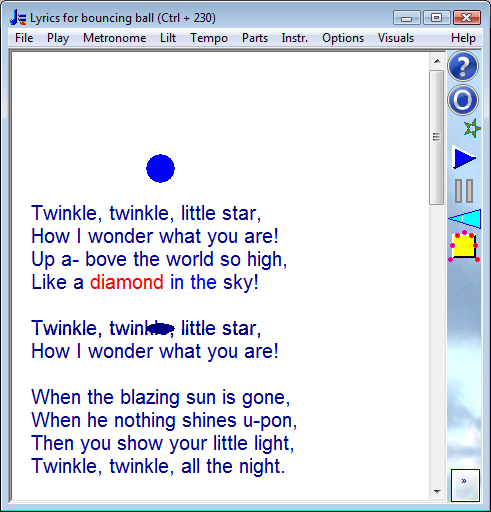
Why do these visuals work so well?It is easy and natural to anticipate the moment when a bouncing ball will hit the ground - so that you can sing, play or clap exactly in time with it. This technique was used in the "Car tunes" movies towards the end of the silent movies era and for the first movies with sound. The ball bouncing on the lyrics helped the audience to sing along with the movie. Bounce Metronome now has a separate "Car Tunes" metronome. As with the original movies, the bouncing ball bounces off the words of the song. The shadow below helps to make the moment of the bounce itself easier to see Here is a video:
Shows the lyrics for greensleeves accompanied with chords from the bounce metronome chord progression player. and a screen shot:
There's an animation of this here: Twinkle Twinkle Little Star - Sound Car Tune Conductors also use the same technique - they will often bounce the baton off an "invisible plane" which makes it easy for the orchestra to anticipate the exact moment of the beat so that they can play along in time. "The motion is like bouncing a golf ball on pavement. Your performers must be trained to play exactly at the bottom of the beat." Indeed, you can use this metronome purely visually even without the tick and still play exactly on the beat even for irregular rhythms such as swing. You can switch off the sound for Bounce Metronome and use it for practice as a silent metronome. With this innovation, the visuals become primary, and it becomes much easier to practise rhythms with swing and irregular beats as you can anticipate the exact moment of an irregular beat visually. The drum stick or conductor's baton visuals let you do this. That's why it is so suitable for rhythms with swing and irregular beats. It is like having your own personal conductor to help you keep in time.
Or download your 30 day Free Test Drive - including your free taster time signature metronome which is yours to keep whether you buy or not
More Videos:Watch Gravity Bounce |



|
|
|
♥ |
| Disclaimer |
| Products - Music - Bounce Metronome |  |
| free of spyware etc |  |